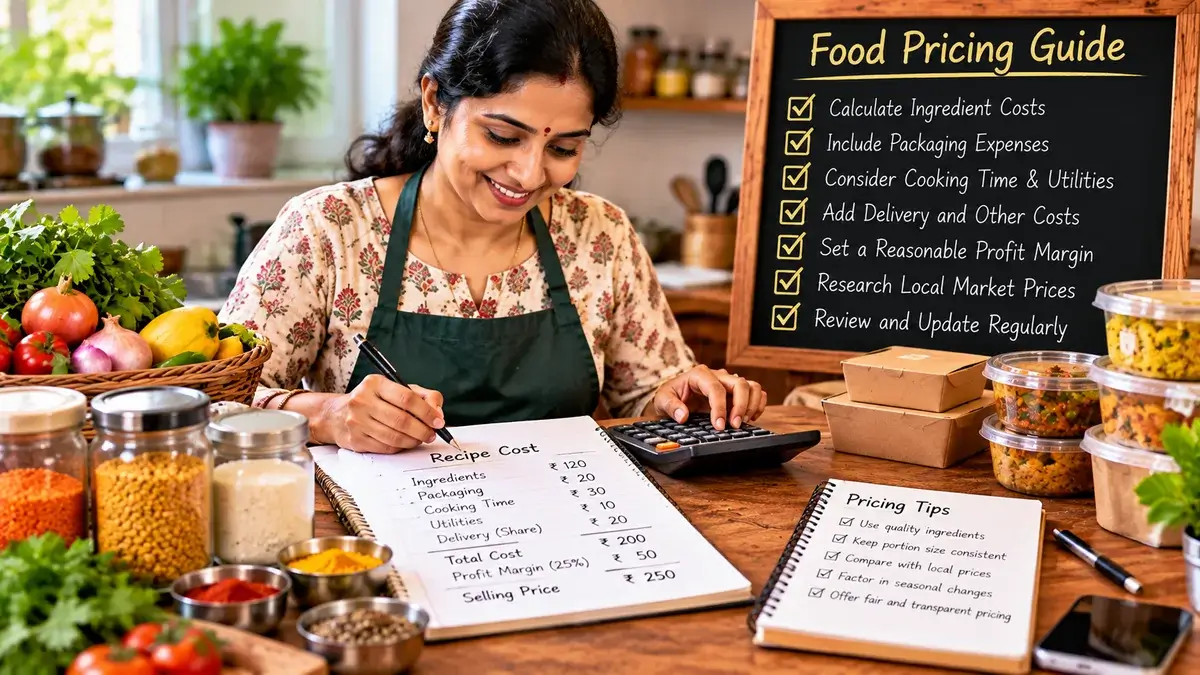
Why Pricing Matters for a Home Food Business
A price that is too low may attract orders but leave little money to pay for the work involved. A price that is too high without a clear reason may make customers hesitate. The aim is to understand the cost of preparing each item, decide what your time is worth and set a price that makes sense for both your business and your customers.
There is no single correct price for every dish. Ingredient quality, portion size, preparation time, local demand and customer expectations differ. A simple costing method gives you a starting point and makes it easier to review prices when costs change.
Do not calculate your selling price from ingredient cost alone. Include packaging, utilities, your labour and other costs that are part of fulfilling the order.
List Every Cost That Goes into the Dish
Ingredients
Include the actual quantities used from flour, rice, vegetables, oil, spices and other ingredients. Use the cost of the quantity consumed, not the price of the entire packet.
Packaging
Count containers, lids, bags, labels, seals, tissues and any other packing material used for each order.
Time and Labour
Account for shopping, preparation, cooking, packing, cleaning and order coordination. Your time is a business cost even if you work from your own kitchen.
Utilities and Overheads
Allow a reasonable share for cooking fuel, electricity, water, cleaning supplies, equipment wear and other recurring expenses.
Waste and Yield
Include trimming, spoilage, failed batches and the difference between raw ingredient weight and the number of saleable portions produced.
Selling and Delivery Costs
Consider applicable platform or payment charges, promotions, delivery expenses paid by the seller and other costs directly related to the sale.
Calculate the Cost per Portion
Start by costing a full recipe. Add the ingredients used, packaging for the batch, estimated utilities and labour, and other relevant expenses. Then divide the total batch cost by the number of portions you can actually sell.
For example, suppose a batch produces 10 saleable portions. If the full batch costs ₹800 after including all relevant costs, the estimated cost is ₹80 per portion. This is an illustration only; use your own ingredient prices, batch yield and time to calculate a realistic figure.
| Example batch cost | Amount |
|---|---|
| Ingredients | ₹400 |
| Packaging | ₹80 |
| Labour allowance | ₹200 |
| Utilities and other overheads | ₹70 |
| Waste and selling-related allowance | ₹50 |
| Total batch cost | ₹800 |
| Saleable portions | 10 |
| Cost per portion | ₹80 |
Illustrative figures only, not a recommended market price.
Set a Selling Price and Profit Target
Once you know the cost per portion, decide the profit you want to earn after covering the costs included in your calculation. Keep the difference between markup and profit margin in mind: adding 20% to a cost is not the same as earning a 20% margin on the selling price.
For a simple starting calculation, if your cost is ₹80 and you add a 25% markup on cost, the price before any separately handled taxes or charges is ₹100. Your profit is ₹20 per portion, which is a 20% margin on that ₹100 selling price. This example is for explaining the arithmetic, not prescribing a target markup.
Choose a target based on your business expenses, customer segment, portion size, local alternatives and the amount of work required. Check applicable taxes, platform fees and payment charges so they are treated consistently in your calculation.
Check Portion Size and Consistency
Customers should have a reasonable idea of what they will receive for the price. Standardise the portion size and recipe as far as practical, and record how many portions each batch produces. If one order includes more food or additional sides than another, the costs may differ.
- Use a consistent serving container or weight measure.
- Record the recipe quantities and batch yield.
- Describe what is included, such as chapati, rice, chutney or accompaniments.
- Recalculate if you change ingredients, portion size or packaging.
Research the Local Market Without Copying Blindly
Look at comparable dishes, serving sizes and what customers receive at similar price points. Compare like with like: a larger portion with premium ingredients is not directly equivalent to a smaller, simpler dish. Market research can help you understand customer expectations, but another seller's price may not cover your own costs.
Ask existing customers for feedback on taste, portion size, packaging and value. Use that feedback alongside your own costing rather than reducing prices automatically whenever someone asks for a discount.
Common Pricing Mistakes to Avoid
- Ignoring your time: Cooking, cleaning and packing are work and should be accounted for.
- Forgetting small expenses: Containers, labels, fuel and payment charges add up.
- Guessing portion yield: Cost the number of portions you can actually sell, not an optimistic estimate.
- Giving frequent discounts without calculating: Check the effect on profit before offering a lower price.
- Using one price for every variation: Premium ingredients, customised portions or extra sides may cost more.
- Failing to update costs: Ingredient and packaging prices can change over time.
Review Prices Regularly
Keep a simple record of recipe costs, batch yield, time spent, packaging expenses and sales. Review it when ingredient prices change, you adjust a recipe, introduce new packaging or notice that an item takes more time than expected. You do not need to change prices for every small fluctuation, but you should know how those fluctuations affect your earnings.
If you revise a price, update your menu clearly and communicate the change before accepting an order. Transparent descriptions and consistent portions help customers understand what they are paying for.
Pricing Homemade Food on Foodishers
Foodishers helps home chefs present homemade food to potential customers. Before listing an item, calculate the full cost, decide the portion size and set a price that accounts for the work and expenses involved. Keep menu descriptions accurate and check any applicable platform charges, payment costs, taxes and delivery arrangements when calculating what you will retain from a sale.
A clear, consistent pricing method helps you make informed decisions as your menu and customer base grow.
Build a More Sustainable Food Business
Review your recipe costs, calculate the cost per portion and set prices with confidence.
Explore Becoming a Home Chef